What is cybersecurity

Lack of cybersecurity is a major risk to businesses today. We read all the time about companies that have been attacked, with a great cost to both the business and the customers. Learn what cybersecurity is and why it is so important and how to work with cybersecurity to protect your critical information and reduce the risk of cyberattacks.
Questions we cover in this article
What is Cybersecurity?
There are several definitions of the word cybersecurity but they all have in common that cybersecurity is
comprises an evolving set of tools, risk management approaches, technologies, training, and best practices designed to protect networks, devices, programs, and data from attacks or unauthorised access.
Benefits of cybersecurity:
Protect networks and data from unauthorized access
Improved information security and business continuity management
Improved stakeholder confidence in your information security arrangements
Improved company credentials with the correct security controls in place
Faster recovery times in the event of a breach
What is the difference between Cybersecurity and Information Security?
Is there really a difference between cybersecurity and information security? One of the main reasons for these two terms to be used interchangeably is that both cybersecurity and information security are related to security and safekeeping a computer system against data threats and information breaches.
But while cybersecurity is about protecting networks, devices, programs, and data from attacks or unauthorised access, information security is above all about preventing information from being leaked, distorted, and destroyed. Information security is also about all data, no matter its form. This means that in information security, the primary concern is protecting the confidentiality, integrity, and availability of the data. In cybersecurity, the primary concern is protecting against unauthorised electronic access to the data.
Want to learn more about information security?

Why is cybersecurity important?
The world relies on technology more than ever before. Businesses and governments store a great deal of data on computers and transmit it across networks to other computers. More and more systems are connected, and as the digitalisation continues this will certainly continue as well.
The digitalisation is not only positive, it also means that we get more vulnerable. Devices and their underlying systems have vulnerabilities that, when exploited, undermine the health and objectives of an organization. And the problem is that the vulnerabilities are being used for cyber-attacks.
Cybersecurity can be used to counteract three types of threats: cybercrime, where single people or groups attack systems for financial gain, cyber warfare, often related to information gathering and politically motivated, and cyber-terrorism, which is intended to undermine electronic systems and cause panic or fear.
What is Cyber hygiene?
Cyber hygiene is a subset of cybersecurity, it’s about the routine and everyday practices that individuals and organisations should follow to maintain security and reduce risks. Some common cyber hygiene mistakes are to reuse passwords across multiple accounts, to click on suspicious links and attachments, to ignore software updates or forget to verify sources before sharing personal information.
Cyber hygiene is essential for maintaining strong cybersecurity and here are some essential cyber hygiene practices:
Strong passwords: Use complex passwords and a password manager.
Multi-Factor Authentication (MFA): Enable MFA for extra security.
Software updates: Regularly update operating systems, apps, and antivirus software.
Phishing awareness: Recognise and avoid phishing emails and scams.
Secure Wi-Fi & VPN Use: Encrypt connections, avoid public Wi-Fi, and use a VPN.
Data backup: Regularly back up important files to an external drive or cloud storage.
Device security: Lock screens, use biometric authentication, and disable unused Bluetooth connections.
Some common cyber hygiene mistakes are to reuse passwords across multiple accounts, to click on suspicious links and attachments, to ignore software updates or forget to verify sources before sharing personal information.
What is Cyber threat?
A more digitalised world means more and more opportunities for attackers to strike. For example, the use of connected “smart” products, also called IoT devices, is increasing rapidly. The more products that are connected to your network, the more ways in exist for a potential attacker.
It has become apparent recently that thinking about security yourself is no guarantee – if your suppliers do not do it. An attack against your supplier can affect you to a very large extent, depending on the part the supplier has in your business.
It has also become more common with cyberattacks with higher aims than making money – attacks on critical infrastructure and national databases are today a fact and are something that can ultimately cost society money, sensitive information, and lives. Despite this, there is currently not enough competence in the cybersecurity area.
Different types of possible cyber threats:
Malware
Malicious software such as computer viruses, spyware, Trojan horses, and keyloggers.
Ransomware
Ransomware is a form of malware that locks or encrypts data until a ransom is paid which may or may not give the victim access to the files again.
Phishing Attacks
The dishonest presentation of e.g. an e-mail or fake website that enables someone to retrieve sensitive information from the person that has received the message/visited the link (for example passwords or credit card information).
Social engineering
The psychological manipulation of individuals to obtain confidential information – this often overlaps with phishing.

What consequences can a cyberattack lead to?
Being exposed to a cyberattack can have serious consequences for the affected organisation, here are some examples:
Productivity losses: Large productivity losses as the attack can lead to interruptions and even longer production stops. The attack can also result in a more lasting deterioration in productivity.
Data breach: Leakage or even loss of personal information about customers. Intellectual property rights are also at risk of being stolen.
Reputational damage: The trust and reputation of the company can be severely damaged, which can lead to difficulties in gaining new customers in the future and difficulties in obtaining financing.
Financial costs: Large costs can arise in connection to the attack, among other things to pay external service providers to solve the problems with shut down computers and more, but also for extra work internally to solve the situation. It can also entail costs if you as a company do not meet the various requirements placed on the business.
Business closure: There is a risk that the company will be forced to close its entire business, at least temporarily, which for a lot of businesses that are based on the fact that they are constantly running is a serious threat.
Who needs cybersecurity?
Infrastructure
Cybersecurity is crucial for organisations that directly affect the nation’s – or world’s – wellbeing and safety. Critical Infrastructure have many national security and safety implications. Cyberattacks to critical infrastructure sectors like energy, transportation, healthcare, and water systems can be catastrophic, causing physical harm or severe disruption in services.
Defence
The defence sector needs cybersecurity to protect national security and military operations, as modern defence systems depend on digital networks for communication, intelligence, and weapons control. Cybersecurity helps protect sensitive data from unauthorized access. Without strong security, cyberattacks could disrupt command systems or compromise missions. That is why cybersecurity is essential to keep defence systems reliable, secure, and operational.
Authorities
For organisations such authorities its essential to work with cybersecurity to protect public services, government systems, and citizen data. Government departments rely on digital networks to manage records, communication, and services. Cybersecurity helps prevent data breaches, identity theft, and disruption of public infrastructure. Without strong protection, cyberattacks could affect law enforcement, emergency services, or national databases.
Industries
Every industry needs cybersecurity because all industries use technology to store and manage information. Cybersecurity helps protect important business data from hackers and cyberattacks. It prevents financial losses caused by data breaches or system damage. Without it, industries are at greater risk of disruptions and security threats.
Which regulations require companies to work with cybersecurity?
During the recent years many new regulations, like the NIS Directive and stricter national security legislation have been implemented.
The NIS Directive aims to promote security measures and boost EU member states’ level of protection of critical infrastructure. In other words, it improves information security of operators in sectors that provide essential services to our society and economy.
The Swedish Protective Security Act clarifies the obligations for companies with security-sensitive activities and the importance of the operators performing security protection analyses for their operations
In 2020 the new EU guidelines regarding cybersecurity for banks came into force. Now it is clearer how various financial services are to manage internal and external risks linked to IT and security.
How do we start working with cybersecurity?
To start with every business or organisation must identify which information that is most critical and thus worth protecting. As most systems today are interconnected it is difficult to have an overview of how many paths that lead to the most valuable information. By using a risk and security assessment, all loopholes can be detected. However, it is neither practical nor economically justifiable to protect all information in the same way.
To secure the most valuable information, strict network segmentation is the best solution to use. This means you create zones with different security levels.When you have created your zones you should choose security solutions for operation, accessibility and adaptability based on the attacker's perspective and the worst-case scenario. To be able to protect your most critical information, make sure to use professional high assurance solutions that are future-proof.
Getting Started with Cybersecurity: 8 Essential Information Security Practices
Realise that information security means more than technology
Information security work has to be linked to your organisation's risk management
Ensure that management takes its responsibility
Review procedures and processes
Ensure that the right resources are available
Start with a security analysis that identifies assets and threats
Develop a security policy (this helps you to maintain information security)
Get help from those with in-depth information security knowledge
Want some more advice on how to invest in your cybersecurity?
Contact us. We are at your service.
Examples of Cybersecurity Solutions

VPN encryptors
Sometimes sensitive information must be communicated over the Internet, but it cannot be sent openly to the recipient. The solution is to use a VPN (Virtual Private Network) encryptor. A VPN protects your network by creating secure, private tunnels between devices or networks, encrypting data while it is transmitted. This ensures that information shared within the private network cannot be read by anyone outside it, safeguarding both the network and the flow of data between units.
Many encryption solutions are software-based, such as those used for remote work. They are affordable and easy to use but are not designed for the highest security levels and may be vulnerable to advanced attacks. Hardware-based encryption solutions are more costly, but they offer stronger protection and are the preferred choice when handling highly sensitive information.
Want to read more about the our solution SecuriVPN?

Security Gateways
A security gateway is a device that controls the information exchange that takes place between different security domains.
If you have security sensitive or even classified information, you may need a solution that offers secure and filtered bidirectional communication. In this case, you need to ensure secure bidirectional communication and be sure that nothing malicious enters your sensitive networks, and that sensitive information and data does not leak to a less sensitive and less protected network.
The purpose is to apply strict information-level control during information transfers and mitigate cybersecurity threats such as manipulation, data leakage and intrusion. A security gateway only forwards received information when it complies with its policy which is derived from your organisation’s information security policy. The policy implemented in the security gateway defines accepted structures, formats, types, values and even digital signatures. When a message is sent from one security domain to another across a security gateway, information in the message is analysed according to the configured policy. Approved parts of the received message are put into a new message which is sent to the intended receiver in the other domain. In this way, you know that only allowed information crosses this boundary.
Our solution is ZoneGuard, read more about it here:
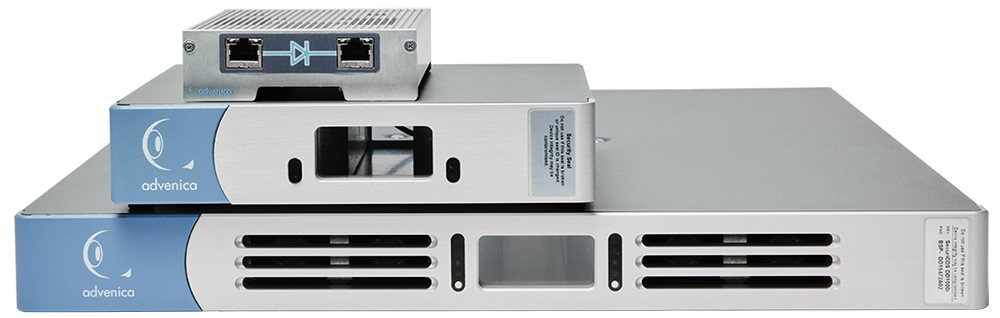
Data diodes
A data diode is a cybersecurity solution that ensures unidirectional information exchange. This high assurance hardware device maintains both network integrity by preventing intrusion, as well as network confidentiality by protecting the most security sensitive information.
Data diodes are the failsafe way to protect sensitive systems and confidential data. Data diodes are small hardware devices, also called “unidirectional security gateways”, which sit between two networks. Working like a check valve, the function of a data diode is to allow all data to pass in the forward direction, while blocking all data in the reverse direction. And as it is not software, it cannot be directly attacked by malicious code, which results in high assurance. Read more about when to use a data diode.
Do you want to learn more about our data diodes?
Firewalls
A firewall protects your network by only allowing certain traffic to enter or exit. It monitors and filters traffic based on rule setups.
With a firewall, it is difficult to know exactly what information is being exported or imported into the system. A firewall configuration often becomes complex, which increases the risk of misconfiguration. Firewalls also do not separate administration and data flow in a way that protects the information from insiders. Organisations that have sensitive information and that operate in critical infrastructure, public sector or the defence industry, need their networks to keep a higher level of security. That is why more solutions than a firewall are often needed.
FAQ
What is a vulnerability in cybersecurity?
A cybersecurity vulnerability is a weak spot in a system, network, software or process that attackers can use to cause damage.
The first step for an organisation to reduce these weak spots is for organisations and employees to practice good cyber hygiene. For example, ignoring the following habits can put an organisation at serious risk:
Use strong and unique passwords, together with a password manager.
Use multi-factor authentication (MFA) for an additional layer of security.
Keep operating systems, applications, and antivirus software up to date.
Establish standards for recognising and avoiding phishing emails, scams, and suspicious links.
Encrypt connections, avoid public Wi-Fi, and use a VPN whenever possible.
Regularly back up important files to an external drive or secure cloud storage.
Lock screens, enable biometric authentication, and disable unused Bluetooth or other connectivity options.
Maintaining these practices is the first step in reducing vulnerabilities and protecting sensitive information across the organisation.
What is phishing in the context of cybersecurity?
The dishonest presentation of e.g. an e-mail or fake website that enables someone to retrieve sensitive information from the person that has received the message/visited the link (for example passwords or credit card information).
What is cybersecurity compliance?
Cybersecurity compliance refers to the process of ensuring that an organisation follows laws, regulations, standards and internal policies related to information security. It involves implementing the necessary controls and procedures to protect data, systems and networks while meeting legal and industry requirements related to the sector the organisation belong to.
If you need guidance on how to achieve compliance, contact us at Advenica. We have extensive experience supporting customers in the defence, infrastructure, authorities, and the industry sector to meet their regulatory obligations.
What is the main purpose of cybersecurity?
The main purpose of cybersecurity is to protect systems, networks, and data from digital threats such as unauthorized access, cyberattacks, and data breaches. Cybersecurity helps organisations to ensure that their information remains confidential, accurate and available when needed.
Contact us
Let's find the right solution for you. We are at your service.

Rickard Nilsson
COO
