OT security – how to enhance it

Learn how to protect your OT environment against cyberattacks. This article covers the security solutions you need and the practical steps to strengthen OT security and safeguard your critical information.
Understanding OT security
Protecting your Operational Technology (OT) environment with the right security solutions is extremely important in today’s digital society. The risks of being hit by a serious attack are constantly increasing and the consequences can be huge, both for the business and for society.
But how do you protect yourself against cyberattacks and what security solutions are needed? Read on and learn what steps you need to take to enhance your OT security and protect your critical information as well as what security solutions that you need.
Questions we cover in this article
What is OT security and why is it important?
Operational Technology (OT) is a concept that includes all the subsystems needed to control and monitor a physical process, for example a power plant or a factory. Today, OT mostly consists of programmable control systems (PLCs) and measuring data collection and control systems (SCADA). The term IT, on the other hand, refers to the business and office-related systems that most organisations use.
OT security is about security and reliability for physical processes and systems, where availability and security are often prioritised over data privacy. This is in contrast to IT security which is primarily focused on protecting data, ensuring confidentiality, integrity and availability of information.
Historically, OT systems have often been completely disconnected from the outside world. With the digitalisation of society, the need to connect OT with the outside world has increased. IT and OT are therefore connected, and often the same type of technology is used in IT and OT. However, the different needs within IT and OT easily lead to technical conflicts that can be challenging to manage.
OT security is often neglected compared to IT security and the conditions are radically different from what most IT operations are used to. There is almost always older but critical equipment combined with restrictions on how to change the facility. You have to have a different approach and manage risks in ways that may be unfamiliar. In addition, there are often direct connections to risks to human life or environmental impact, which causes the risk analysis to be very different.
Why are threats to critical infrastructure and OT increasing?
Critical infrastructure, such as electricity distribution, water supply, transport and telecommunications, is today dependent on IT systems to control and monitor the processes that form the basis of these operations. Industrial control systems such as ICS (Industrial Control System) or SCADA (Supervisory Control and Data Acquisition) are therefore crucial for our modern society to function. These functions can be collection and processing of measurement data, log management, management of control units and sensors, invoicing in real time, etc.
Managing support remotely means lower costs and improves efficiency. But it also leaves the business more open to information leaks and cyberattacks, which can have devastating effects.
What approaches can threat actors use to disrupt OT systems?
In the industrial sector, ransomware attacks are the most common form of attack affecting operations. Here are some examples of ways to disrupt OT systems.
Malware of various kinds
Attacks that spread from IT to OT systems
Force operators to shut down OT infrastructure to reduce the risk of spreading to or within the OT network
Exfiltration of sensitive information about the OT system
Reasons to why attackers will continue to target OT systems
OT systems continue to be interconnected with other systems (eg IT systems, the cloud and various subcontractors), increasing the chances for attackers to enter OT via these other systems
There may be a greater risk of organisations paying ransoms to make critical systems available again
ENISA recommends that organisations with OT systems deal with the most common problems in OT, such as insufficient network segmentation, remote access to OT and shared user accounts.
ENISA recommends that organisations with OT systems deal with the most common problems in OT, such as insufficient network segmentation, remote access to OT and shared user accounts.

What consequences does cyberattacks have on our OT security?
Major productivity losses
As the attack can cause interruptions and production stops. The attack can also mean a more lasting deterioration in productivity and quality.Leakage or even loss of information
Intangible assets are at risk of being stolen.Negative impact on reputation
A company’s trust and reputation can be seriously damaged, making it harder to attract new customers and secure financing.Financial disruption
Attacks often result in high costs for forensic investigations, system recovery, and internal work to fix the problem. But also costs for potential fines for failing to meet legal or regulatory requirements which are placed on the business.Operational downtime
There is a risk that the company will be forced to shut down the entire operation, at least temporarily, which for a lot of businesses that are based on being constantly in operation is a serious threat.
Do you have questions regarding how to protect information in operations within critical infrastructure?
Contact us. We are at your service.
What are the regulatory requirements for OT security?
IEC 62443 is a standard you who work with security within ICS systems should know. The purpose of the standard is to improve the integrity, availability and confidentiality of the components. The standard also specifies criteria that can govern how to implement secure systems and consists of four parts: general, policies and procedures, system and component. Broadly speaking, it can be said that the standard concerns requirements and processes for security within ICS systems.
Among other things, it is mentioned that users must be authenticated before they gain access to the system (which may seem obvious) and that they must be given the right level of rights, as well as that their activities must be monitored.
It must also be ensured that the systems cannot be manipulated or that the type of information contained in the systems cannot be revealed without permission. Another aspect is that the availability of the systems’ important functions must be ensured, which in other words is called resilience. The systems must also be divided into zones and the data flow between these zones must be limited.
It is of great importance that there is a system for incidents, so-called incident management. Violations must therefore be reported to the right authority and it must also be ensured that measures are taken to deal with the violation.
How do we protect our business against cyberattacks?
To begin with, every company or organisation must identify the information or systems that are most critical and thus worth protecting. Since most systems today are interconnected, it is difficult to get an overview of how many paths lead to the most valuable information. By conducting a risk and vulnerability analysis, protect-worhty information and systems can be classified and loopholes identified.
However, it is not practical or financially justified to protect all information in the same way. To secure the most valuable information, strict network segmentation is the best solution to use. This means that you create zones with different security levels.
After creating zones, you should choose security solutions for operation, availability, and adaptability based on the attacker’s perspective and worst-case scenario. To be able to protect your most critical information, be sure to use professional solutions for high security and also solutions that are future-proof. Some such solutions are data diodes, security gateways and vpn-crypto solutions.
Tips to protect yourself and your business against cyber attacks
Segment your networks
Make demands on your subcontractors
Update securely
Important elements to include when creating your OT security strategy
Asset Management: Maintain an accurate inventory of all OT assets.
Risk Management: Implement a robust risk management process.
Incident Response Plan: Develop and regularly test an incident response plan tailored to OT.
Continuous monitoring: Implement continuous monitoring and anomaly detection systems.
Physical Security: Ensure physical security measures are in place to protect OT assets.
How do we make a secure IT/OT integration according to IEC 62443
According to the IEC 62443 standard, you need to take the following 5 steps to secure your IT/OT integration:
Identify the system
Initial risk analysis
Zoning and data flows
Detailed risk analysis
Design
What can we achieve with secure IT/OT integration?
There are several things you can do once you have secured your IT/OT integration:
Connect the OT environment to the cloud
Make AI analysis of production data
Continue your digitalisation journey
Send highly classified information over the Internet
What Cybersecurity solutions is there for OT security?

VPN encryptors
Sometimes sensitive information must be communicated over the Internet, but it cannot be sent openly to the recipient. The solution is to use a VPN (Virtual Private Network) encryptor. A VPN protects your network by creating secure, private tunnels between devices or networks, encrypting data while it is transmitted. This ensures that information shared within the private network cannot be read by anyone outside it, safeguarding both the network and the flow of data between units.
Many encryption solutions are software-based, such as those used for remote work. They are affordable and easy to use but are not designed for the highest security levels and may be vulnerable to advanced attacks. Hardware-based encryption solutions are more costly, but they offer stronger protection and are the preferred choice when handling highly sensitive information.
Want to read more about the our solution SecuriVPN?

Security Gateways
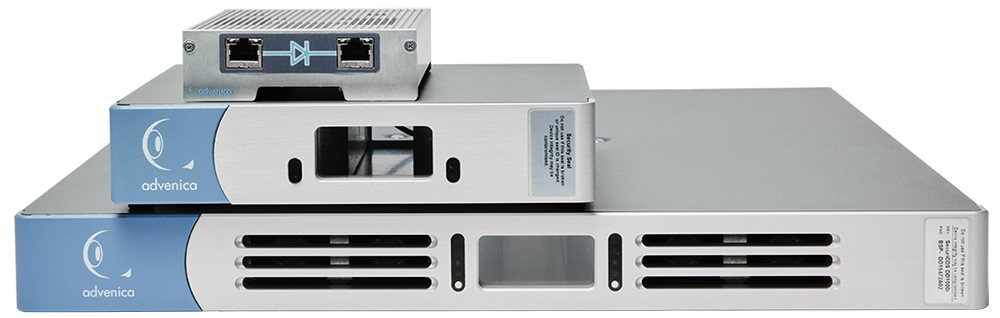
A security gateway is a device that controls the information exchange that takes place between different security domains.
If you have security sensitive or even classified information, you may need a solution that offers secure and filtered bidirectional communication. In this case, you need to ensure secure bidirectional communication and be sure that nothing malicious enters your sensitive networks, and that sensitive information and data does not leak to a less sensitive and less protected network.
The purpose is to apply strict information-level control during information transfers and mitigate cybersecurity threats such as manipulation, data leakage and intrusion. A security gateway only forwards received information when it complies with its policy which is derived from your organisation’s information security policy. The policy implemented in the security gateway defines accepted structures, formats, types, values and even digital signatures. When a message is sent from one security domain to another across a security gateway, information in the message is analysed according to the configured policy. Approved parts of the received message are put into a new message which is sent to the intended receiver in the other domain. In this way, you know that only allowed information crosses this boundary.
Our solution is ZoneGuard, read more about it here:
Data diodes
A data diode is a cybersecurity solution that ensures unidirectional information exchange. This high assurance hardware device maintains both network integrity by preventing intrusion, as well as network confidentiality by protecting the most security sensitive information.
Data diodes are the failsafe way to protect sensitive systems and confidential data. Data diodes are small hardware devices, also called “unidirectional security gateways”, which sit between two networks. Working like a check valve, the function of a data diode is to allow all data to pass in the forward direction, while blocking all data in the reverse direction. And as it is not software, it cannot be directly attacked by malicious code, which results in high assurance. Read more about when to use a data diode.
Do you want to learn more about our data diodes?
Does Advenica offer the solutions we need?
What are your security challenges?
Do you need to securely integrate IT and OT systems?
Do you need to secure your remote access?
Do you want to be able to transfer sensitive information from a SCADA system?
Need to find a secure solution for traceability and logging?
Want to avoid the security risks of updating your systems?
Do you need secure communication with remote sites?
Do you need guidance regarding digital responsibly or on what solution that meets your business needs? Contact us. We are at your service.
FAQ
Why do you need to protect your information?
Availability: So that the Information is accessible whenever it is needed.
Integrity: So that we can trust that the information is correct and has not been tampered with, altered, or destroyed by unauthorized parties.
Confidentiality: So that authorised persons may take part in it.
What is the main purpose of cybersecurity?
The main purpose of cybersecurity is to protect systems, networks, and data from digital threats such as unauthorized access, cyberattacks, and data breaches. Cybersecurity helps organisations to ensure that their information remains confidential, accurate and available when needed.
What is network segmentation?
Network segmentation means dividing a data network into smaller subnetworks, or segments. This helps increase security by limiting access and containing potential threats, and can also improve overall network performance.
Which organisations should implement network segmentation?
Organisations that handle sensitive information, such as those in defence, authorities, infrastructure, and industry.
Why is cybersecurity for OT so important?
Cyberattacks on operational technology (OT) are increasing, making cybersecurity critical to prevent attacks that could lead to serious consequences for a company:
Major production stops
Leakage or loss of sensitive information
Negative impact on the organisation’s reputation
Significant financial disruption
Risk of temporary business shutdown
What are the benefits of network segmentation?
Network segmentation helps organizations strengthen their cybersecurity by reducing risk and limiting the impact of cyberattacks. Without it, there is a risk that sensitive information can leak or be manipulated, and that malware and ransomware can spread uncontrollably and quickly.
Sectors We Serve


Contact us
Let's find the right solution for you. We are at your service.

Rickard Nilsson
COO
